
Brigid has been coming up a LOT these days.
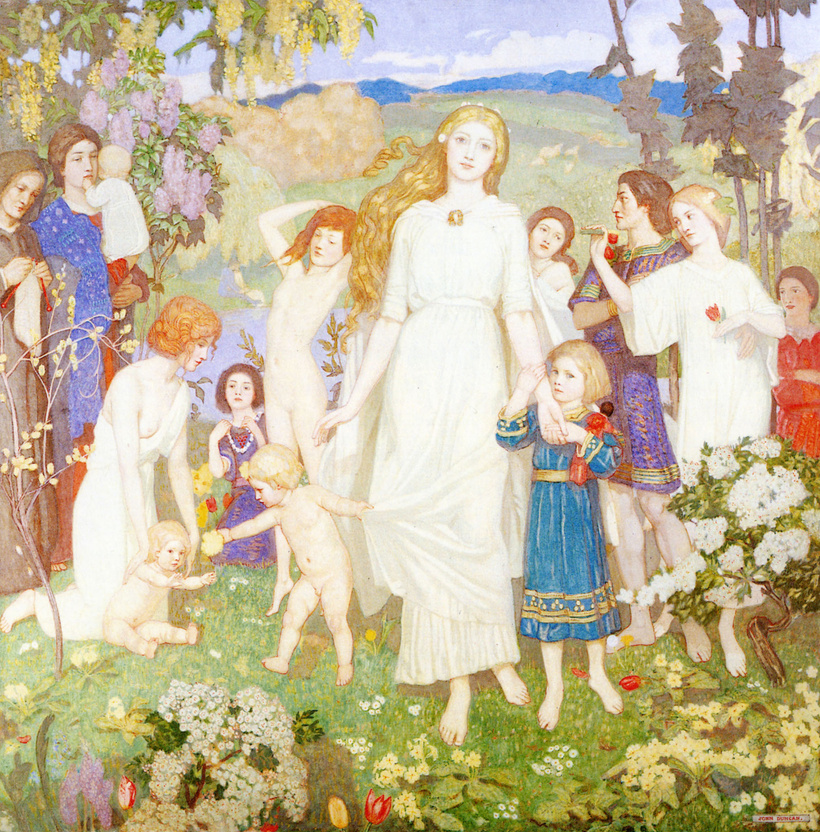
“The Coming of Brigid” by John Duncan
Cauldron Content With Courtney Weber is a reader-supported publication. To receive new posts and support my work, consider becoming a free or paid subscriber.
She was the first Goddess I came across in my early Pagan journey. She shaped my early adulthood. And by that I mean she acted like a smith: sticking me in the forge and pounding the crap out of me until I shaped up.
We’ve had our ups and downs, Brigid and I. Don’t let anyone fool you into thinking she’s an “easy” Goddess. Loving, yes. But gentle or “easy,” nope.
But why IS she coming up for people so much these days?
For the past few years, I’ve been regularly asked to speak on The Morrigan and Hekate, two Goddesses I adore and never get tired of talking about. But people haven’t sought me out for Brigid. Those winds have shifted. I’ve been talking more about Brigid in the past month than I have in the last few years!
Here is why Brigid is suddenly on people’s minds…
We are in complicated times.
Dictators are overthrown…but at what cost to their people? Horrific truths are coming to light…but what consequences will their perpetrators face, if any? We may show up to help, but all too often, our good intentions are clumsy and make things worse!
Brigid is a Goddess of complicated times.
In the Cath Maige Tuired, Brigid (Bríg ) marries and has a child with Bres, the king of the Fomorians, who has oppressed her own people. When her people rose up, one of her sons, Rúadán, acted as a spy—sharing her people’s secrets of Magick and warfare, and attempting to assassinate Goibnui—one of the great craftsmen of the Tuatha De and also one of Brigid’s kin:
(Goibnui) drew the spear out of himself and cast it at Rúadán so that it went through him. Then he died in front of his father at the parliament of the Fomoire.
Bríg came and keened for her son. First she cried out, then she wept.
It was [as though? / ] then that weeping and crying were first heard in Ireland.
(It is she also who is the Bríg that created a hiss to signal at night.)
Source: The Story Archeology Project. Edited by Elizabeth Gray. Translation by Isolde Carmody.
Many people may relate to this story for a host of reasons. Some of which might include:
- Feeling powerless in the middle of a complicated situation
- Watching someone you love do something to harm others
- Being alone in grief
This is the power of myth.
A myth does not necessarily contain historical fact, but it can contain truth.
Myth can shape our understanding.
Myths can reflect our experiences.
Myth can inspire action.
Tonight, consider lighting a candle to Brigid.
Share your story with her. Ask for guidance. Seek understanding. In some cases, it may be helpful to seek acceptance, too.