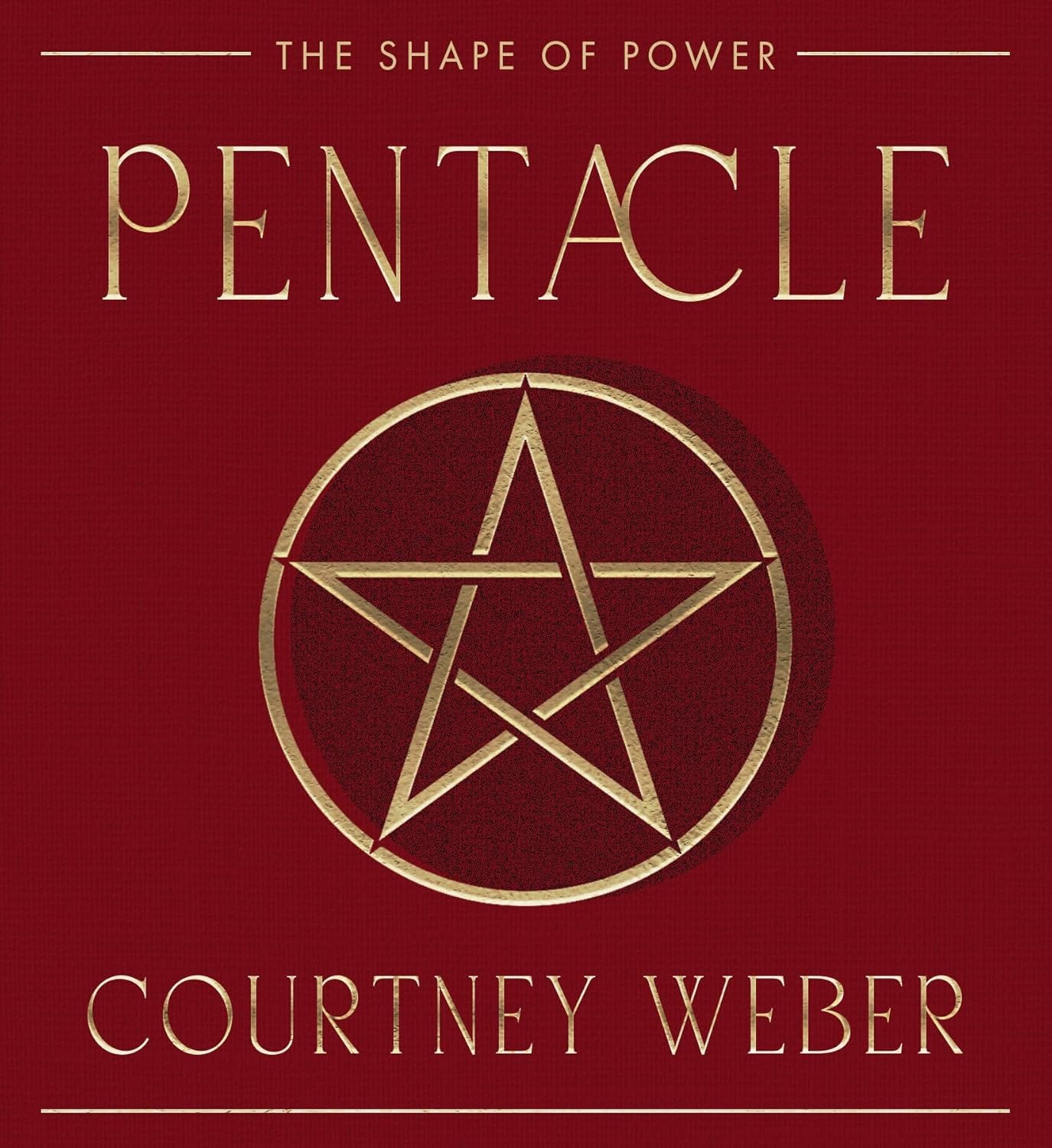
Hey all! This week, I’m offering a sneak preview of my newest book The Pentacle: The Shape of Power.
Seriously, friends—I had SO much fun writing this book.
I found myself looking into ancient Mesopotamian hieroglyphs as well as Yippies levitating the Pentagon building. What other book has all of that???
The Pentacle is available for pre-order. Pre-orders are a BIG help to authors, so if the following passage interests you even a little, please consider pre-ordering as it means the world to me.

When I embraced the Witchcraft path, I bought a pentacle ring (one I still wear to this day), and wore it in public, waiting on the world’s reaction. Most people didn’t notice. The few that did were split into sneers and fears. Some laughed and said I was ridiculous. Others backed away from me, as though wearing such a simple little ring would throw evil at them. Still others wanted to know me better: “If you’re a Witch, can you teach me to be one, too?” The pentacle made a statement. For me, it was a symbol of my personal faith. Why did it have such an impact? Couldn’t I wear a pentacle as a symbol of my faith in the way that other religious people wore symbols of theirs, such as a cross or a Star of David?
The truth was not so simple. For millennia, the pentacle has held a variety of reputations: a tool for summoning spirits, a symbol to ward off evil, an indication of an occult order, and eventually a poignant symbol of counter-cultural thought and spirituality. It has been an integral part of modern Western culture for decades in visual art, music, film and fashion. But no matter its supposed symbolism, or whether displayed in media, rituals, or jewelry, the pentacle means power.
The pentacle, and the pentagram shape encased within it, is found in nature and has fascinated humans for thousands of years. Yet the shape has also developed a very specific reputation for controlling spirits, invoking power, and most recently in its evolution, most often marking its wearer as a self-identified Witch.
But Witches haven’t always used the pentacle. For the good part of human history, practices called Witchcraft had few symbols at all. The Witch was known more for what they did (creating potions, casting spells, communing with spirits) than by the jewelry they wore.
How did the pentacle become a power symbol of the Witch?
In exploring the pentagram, I found myself immersed in sacred geometry, ancient orders and even older hieroglyphs, European occult and architectural history, re-orienting myself with the first practices that influenced me, and connecting with old friends. I found pockets of Magick that I haven’t thought to explore—both through the journeys of the ancient world, the wild minds of the great mathematicians, and connecting with a ritual occult world that I have long thought wasn’t for me, but had plenty of wonderful things to teach me.
The pentacle is, and has been, many things: A simple artistic design, a mark of a blessing, a symbol used to control spirits, a talisman, the shape of an energetic practice, a symbol of rebellion, a religious icon. It represents power but also limits. It signifies the body but also the unexplored spirit. It signifies identity. It inspires fear as well as wonder.